1001 S Main St, Kalispell, MT 59901, US
arominx That Ensures Your IT Runs Seamlessly, Anytime and Every Time


We specialize in custom software, AI integration, website development, and branding to help your business scale efficiently.
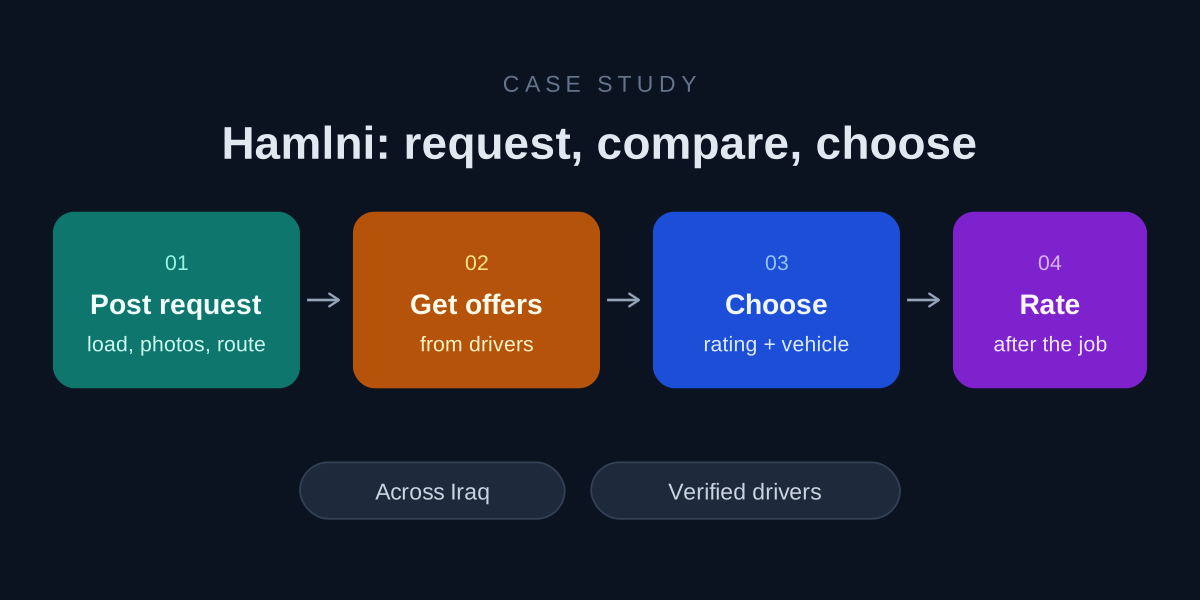
Moving a sofa, a fridge or a shop's worth of stock sounds simple until you try to arrange it. You call around, describe the load over and over, get a price that may or may not be fair, and hope the driver turns up with the right vehicle. Hamlni (حملني) was built to replace that chain of phone calls with one clear process.
Hamlni is an online transport marketplace for Iraq. It connects customers who need furniture, large items or goods moved with drivers who offer transport. It is live on Android and on the web, and it covers all governorates of Iraq. We built it at Arominx, and this post explains what it does and why it is designed the way it is.
The problem it addresses
Informal transport markets run on personal contacts. That works until you need a driver you do not know, in a city you do not live in, for a load you cannot easily describe. Three questions come up every time: can I trust this driver, is this price reasonable, and what happens if something goes wrong?
Hamlni is built around those three questions rather than around a vehicle map.
How it works for customers
The website lays the process out in four steps:
1. Create a transport request. The customer describes the load, can add photos, and sets the pickup and delivery locations.
2. Receive offers. Drivers respond with their own prices.
3. Choose the best offer. Each driver's rating and vehicle type are visible before the decision.
4. Complete the job and rate the experience.
Customers can request pickup trucks, vans, small trucks, large trucks and refrigerated trucks, so the same flow covers a one-room move and a cold-chain delivery.
How it works for drivers
Drivers can join the platform and take jobs that fit their vehicle and route. The site says new drivers get their first six months of subscription free, which lowers the barrier to trying it. Driver and vehicle details go through verification, and ratings build up over time, so good work becomes visible to the next customer.
The features that matter, in plain terms
The site highlights six things: verified drivers, multiple offers, competitive prices, ease of use, complaints support and real reviews. Together they answer the three questions above. Verification speaks to trust, multiple offers to price, and complaints support and reviews to what happens when something goes wrong.
Three design decisions worth explaining
1. Let customers compare instead of fixing a price. Hamlni does not set one rate. Drivers send offers, and the customer sees several side by side. This suits a market where loads, distances and road conditions vary a lot, and it keeps prices a negotiation between two parties rather than a number imposed by the platform.
2. Show the evidence next to the price. A price alone is a weak signal. Showing the driver's rating and vehicle type beside each offer lets people weigh cost against reliability, and the cheapest option is not always the best one.
3. Build for Arabic first. The site is in Arabic and laid out right to left, because that is how the audience reads. Right-to-left support is easy to bolt on badly and expensive to fix later, so it was part of the design from the start.
A note on responsibility
Hamlni is clear that it connects customers and drivers and does not take responsibility for prohibited, hazardous or illegal goods. Users are expected to follow local laws. Being upfront about what a marketplace does and does not do protects everyone involved, and it is worth deciding early if you build one.
Shipping in the open
The Android app is live on Google Play, with the website running alongside it. It is a young product, so we are not going to quote download figures or results it has not earned yet. What we can say is what it is built to do, and that it is available to try today.
What this means if you are planning a marketplace app
- Start with trust, not features. In a two-sided marketplace, verification, ratings and a way to complain do more for repeat use than any extra screen.
- Pick a flow people already understand. Post a request, get offers, choose one is close to how people already hire help, so it needs little explanation.
- Design for your language and reading direction from day one. Retrofitting right-to-left layouts is painful.
- Give the supply side a reason to join. A free introductory period for drivers is a simple way to build supply before demand arrives.
- State the platform's role clearly. Say what you connect and what you do not guarantee.
Try Hamlni
Website: https://hamlni.com/
Google Play: https://play.google.com/store/apps/details?id=com.hamlni.app
Planning a marketplace of your own?
At Arominx we build mobile apps, web platforms and custom software for businesses that want to launch something real. If you are thinking about a marketplace, logistics or on-demand app, tell us about it at arominx.com and we will talk through what it could look like.
